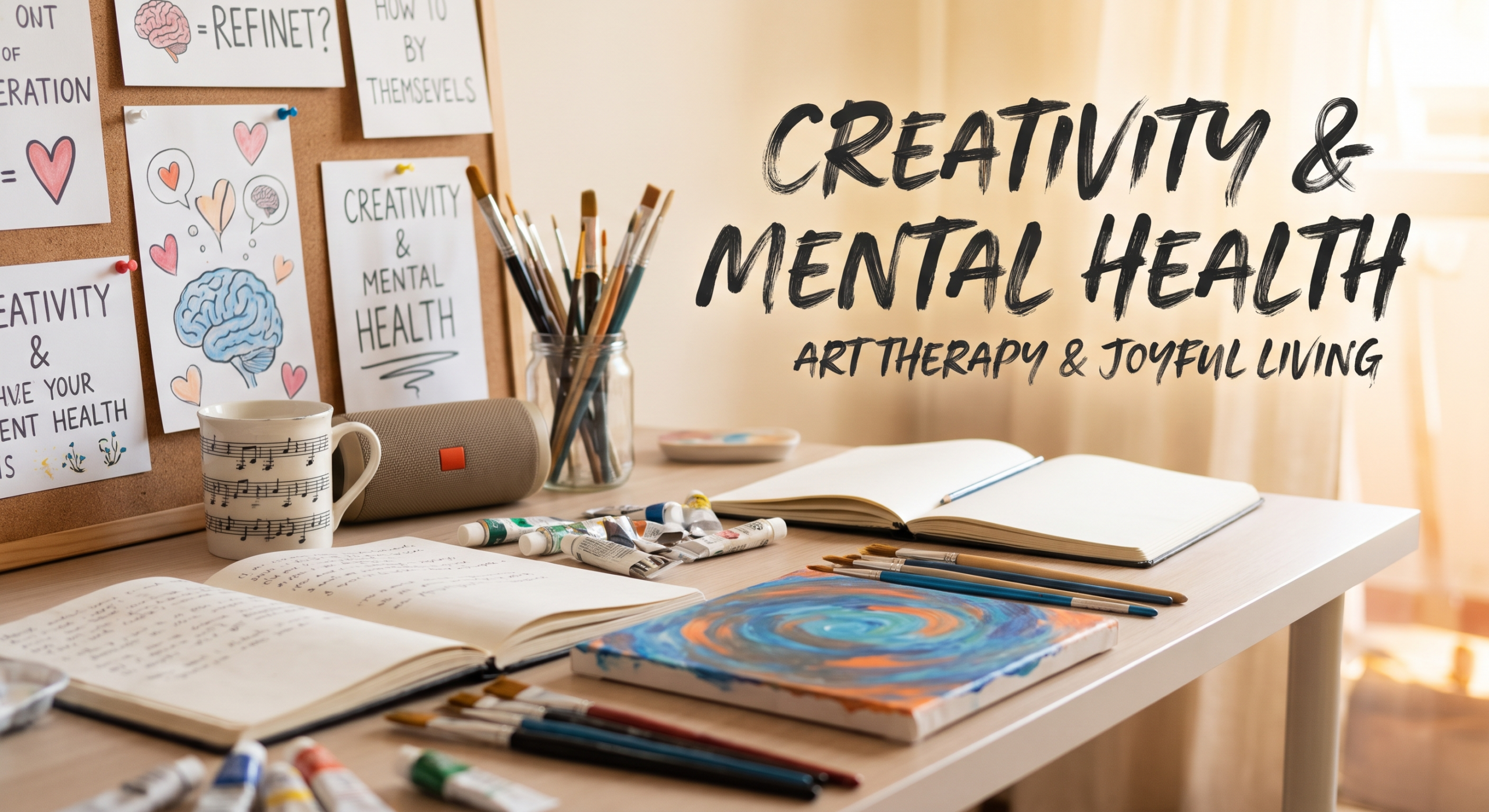
Humans have used creative expression for psychological healing since long before the field of psychology existed. Cave paintings, tribal drumming, storytelling, dance — creative practices are woven into the fabric of human culture precisely because they serve our deepest psychological needs. Today, a robust body of scientific research confirms what ancient wisdom always knew: creativity is not a luxury or a talent reserved for artists. It’s a fundamental human need with measurable impacts on mental health, emotional processing, and brain function.
The Neuroscience of Creativity and Mental Health
Creative activities engage multiple brain networks simultaneously in ways that few other activities do. Understanding this neurological basis helps explain why creativity is so therapeutically powerful.
The Default Mode Network and Creative Flow
The brain’s default mode network (DMN) — associated with self-referential thinking, imagination, and perspective-taking — is highly active during creative states. Interestingly, the DMN is often suppressed in people with depression and anxiety, whose minds are stuck in ruminative, hypervigilant states. Creative activities naturally activate the DMN, providing access to the imaginative, flexible thinking that depression suppresses.
Dopamine and the Reward of Creation
Completing a creative work — finishing a painting, writing a song, finishing a poem — triggers dopamine release in the brain’s reward system. This is the same neurochemical pathway activated by food, sex, and social connection. Regular creative practice essentially trains the brain to find reward and motivation in acts of personal creation, counteracting the anhedonia (inability to feel pleasure) that characterizes depression.
Flow State and the Quieting of the Inner Critic
Mihaly Csikszentmihalyi’s research on flow — the state of complete absorption in a challenging, meaningful activity — shows that flow states are characterized by reduced activity in the prefrontal cortex’s self-monitoring regions. In other words, deep creative engagement temporarily silences the inner critic, the source of much psychological suffering. Regular flow experiences are associated with higher life satisfaction, meaning, and psychological wellbeing.
Art Therapy: Clinical Evidence
Art therapy is a well-established clinical practice with decades of research supporting its effectiveness across a range of mental health conditions.
Trauma Processing Through Art
For trauma survivors, verbal articulation of experiences is often impossible or retraumatizing. Art therapy provides a non-verbal language through which traumatic memories can be processed and integrated. Studies show art therapy reduces PTSD symptoms, helps children who have experienced abuse communicate their experiences, and supports veterans in processing combat-related trauma.
Art Therapy for Anxiety and Depression
A 2016 review in the Journal of Affective Disorders found that creative arts therapies (including art, music, and dance) produced significant reductions in depression and anxiety symptoms. The tactile, present-moment focus of visual art-making — mixing colors, feeling the texture of clay, the rhythm of brush strokes — naturally induces mindfulness states that counteract anxious and depressive thought patterns.
Music and Mental Wellness
Music is arguably the most universal human creative activity, present in every known culture. Its psychological effects are profound and well-documented.
Music for Stress Reduction
Listening to music at approximately 60 beats per minute — the resting heart rate — synchronizes brainwaves to alpha and theta states associated with relaxed alertness. Research shows that music listening reduces cortisol levels, blood pressure, and heart rate during stressful tasks. In surgical settings, music reduces pre-operative anxiety more effectively than sedative medications in some studies.
Active Music-Making vs. Passive Listening
Both listening and making music benefit mental health, but actively making music — singing, playing an instrument, drumming — produces additional benefits. Group music-making (choir, drum circles, band) stimulates oxytocin release and fosters social connection, a primary predictor of longevity and mental health. Even informal humming or singing while doing household tasks has documented mood-lifting effects.
Music Therapy for Depression and Dementia
Clinical music therapy — facilitated by trained therapists — shows strong evidence for reducing depression severity and improving quality of life. In dementia patients, familiar music can unlock memories and emotional responses even when verbal communication has deteriorated, demonstrating music’s unique access to deep emotional and autobiographical memory networks.
| Creative Activity | Primary Benefit | Evidence Level | Time Required | Accessibility |
|---|---|---|---|---|
| Visual art making | Trauma processing, mindfulness | Strong | 30+ min sessions | Medium (materials) |
| Music listening | Stress reduction, mood | Very strong | Any duration | Very high |
| Music making | Connection, flow, mood | Strong | Varies | Medium |
| Writing/journaling | Emotional processing, insight | Very strong | 15-30 min | Very high |
| Dance/movement | Body awareness, mood | Strong | 20+ min | High |
| Play (unstructured) | Joy, stress relief, creativity | Strong | Any duration | Very high |
The Healing Power of Play
Play is not just for children. Stuart Brown’s research at the National Institute for Play demonstrates that play is a biological drive in humans throughout life, with profound impacts on brain development, social connection, and mental wellbeing.
What Is Play for Adults?
Play is any activity done for its own sake, with no extrinsic goal, where the process is the point. This could be improvisation games, building LEGO sets, cooking creative meals, gardening, playing board games, recreational sports, or making up silly songs. The defining characteristic is intrinsic motivation and the absence of serious consequence.
Play, Stress, and Resilience
Animal studies show that play deprived animals become hyperreactive to stress and struggle to regulate emotions appropriately in social contexts. Human research mirrors this: adults who engage in regular play report higher stress tolerance, better problem-solving under pressure, and stronger social relationships. Play literally exercises the neural circuits needed for emotional regulation.
Creative Writing and Narrative Therapy
Writing — journaling, poetry, fiction, memoir — is among the most accessible and well-researched creative mental health interventions.
Expressive Writing Research
James Pennebaker’s decades of research on expressive writing shows consistent physical and psychological health benefits: reduced stress hormone levels, improved immune function, faster wound healing, lower healthcare utilization, and better psychological wellbeing. The key is writing that explores both the facts and the emotional meaning of difficult experiences.
Poetry and Emotional Processing
Poetry’s compression of language forces writers to identify the essential emotional truth of an experience. The constraints of form (meter, rhyme, line breaks) also engage the analytical left brain alongside the emotional right brain, creating an integrative processing experience that prose journaling alone may not achieve.
Frequently Asked Questions
Do I need to be artistic or talented to benefit from creative activities?
Absolutely not. The mental health benefits of creativity are entirely independent of skill or aesthetic quality. Therapeutic value comes from the process of making — the engagement, expression, and attention — not the product. Many art therapists deliberately encourage clients to abandon ideas of “good” or “bad” artwork.
How much time do I need to spend on creative activities to see mental health benefits?
Research suggests that even 20–45 minutes of creative engagement can produce measurable reductions in cortisol and mood improvement. Regular brief sessions (20–30 minutes, 3–5 times per week) appear to produce more sustained benefits than occasional longer sessions.
Can creativity replace professional mental health treatment?
Creative practices are powerful supportive tools but are not replacements for professional treatment of clinical mental health conditions. They work best as part of a comprehensive approach that may include therapy, medication, lifestyle interventions, and social support.
What if I find creative activities stressful rather than relaxing?
This is common, especially if you have perfectionist tendencies or associate creativity with performance and judgment. Start with low-stakes, playful activities — doodling, coloring books, drumming with fingers — rather than high-stakes artistic endeavors. The goal is process, not product.
Are there specific creative activities recommended for depression?
Physical creative activities — dance, pottery, drumming — are particularly beneficial for depression because they engage the body and counteract the physical withdrawal that depression produces. Music listening and making also have strong evidence bases. Any activity that generates even mild interest or pleasure is valuable when depression flattens motivation.
How does creative activity compare to other mental health interventions?
Creative arts therapies show effect sizes comparable to other active psychological interventions, and they tend to be more engaging and less stigmatizing than traditional therapy for many populations. They’re particularly valuable for people who struggle with verbal articulation of emotions — including children, trauma survivors, and those from cultures where direct emotional discussion is uncommon.
Conclusion
Creativity is not an indulgence — it is a psychological necessity. The research is clear: regular engagement with creative activities, whether visual art, music, writing, movement, or play, produces measurable benefits for mental health, emotional resilience, and quality of life. You don’t need talent. You need only the willingness to make, express, and play. Start today with five minutes of something that engages you — doodle, hum, write a few lines, dance alone in your kitchen. Your nervous system will thank you.


