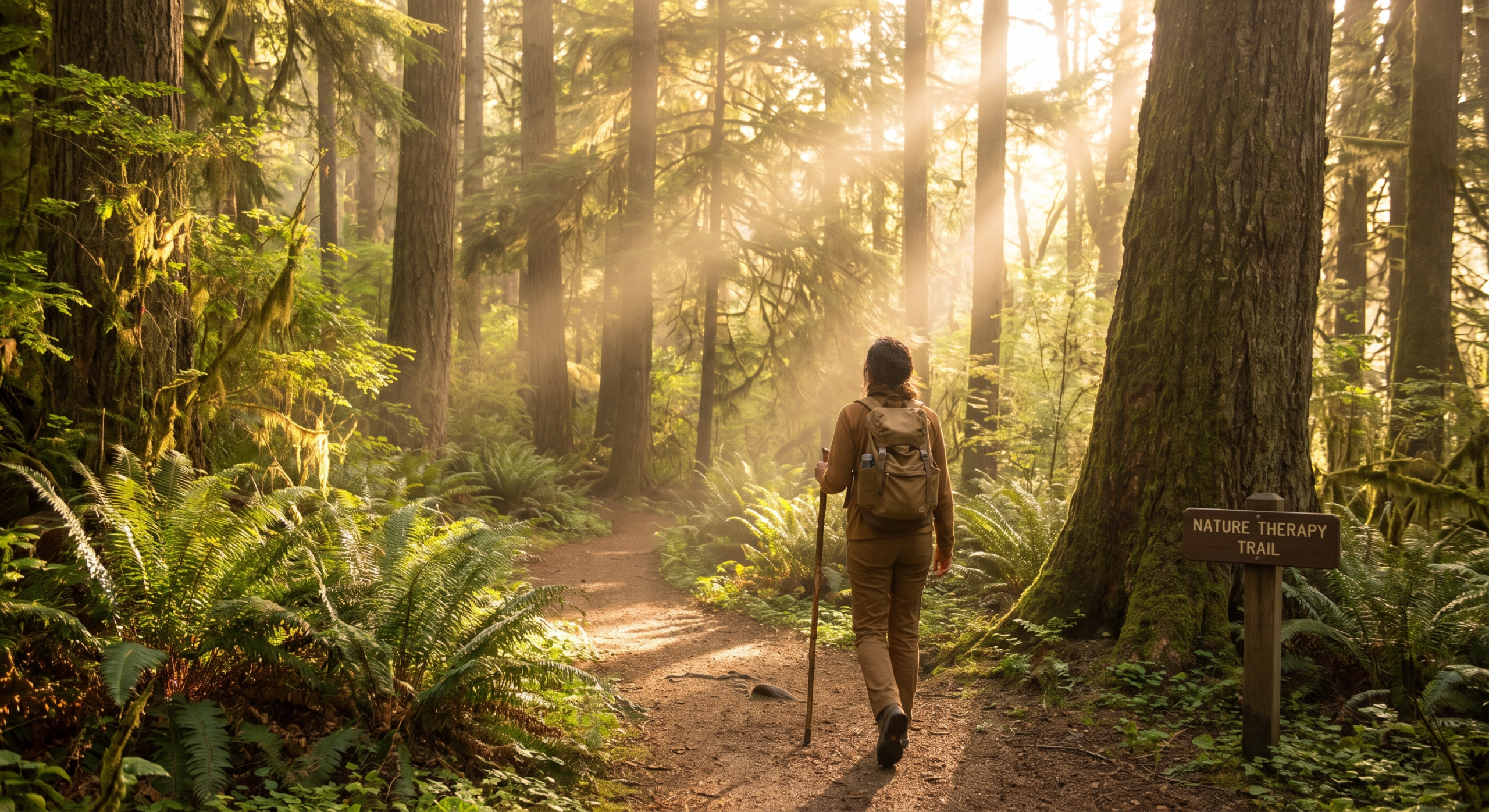
Something fundamental happens to human psychology when we step outside into natural environments. Heart rate drops. Cortisol levels fall. Rumination quiets. Mood lifts. These aren’t subjective impressions — they’re measurable physiological and psychological changes documented across hundreds of studies. As urbanization concentrates more of the world’s population into built environments and screen time occupies an ever-larger share of waking hours, understanding how and why nature affects mental health has become one of the most practically important areas of psychological science.
The Science of Nature and the Stress Response
Two major theoretical frameworks explain why natural environments reduce psychological stress, and both are supported by substantial empirical evidence.
Attention Restoration Theory
Attention Restoration Theory (ART), developed by Rachel and Stephen Kaplan, proposes that natural environments restore a depleted cognitive resource called directed attention — the focused, effortful concentration required for most modern work. Natural settings engage “soft fascination” — gentle, involuntary attention that doesn’t deplete directed attention and allows it to recover. Urban environments, in contrast, constantly demand directed attention through traffic, noise, crowds, and competing stimuli.
Stress Recovery Theory
Roger Ulrich’s Stress Recovery Theory argues that humans evolved in natural environments and retain an innate physiological response to natural settings that promotes recovery from stress. Exposure to natural scenes — particularly those with water, trees, open vistas, and moderate complexity — triggers the parasympathetic “rest and digest” nervous system response, reducing heart rate, blood pressure, cortisol, and muscle tension within 4–7 minutes.
What the Research Measures
| Outcome Measured | Effect of Nature Exposure | Timeframe |
|---|---|---|
| Cortisol (stress hormone) | Significant reduction | Minutes |
| Heart rate / blood pressure | Measurable decrease | 5–10 minutes |
| Rumination / negative thinking | Reduced activity in subgenual PFC | 90-minute walk |
| Depression symptoms | Moderate reduction | Weeks of regular exposure |
| Anxiety symptoms | Moderate reduction | Immediate and cumulative |
| Cognitive performance | Improved focus and working memory | Minutes to hours |
Green Spaces and Mental Health Outcomes
Population-level research consistently finds that proximity to green spaces correlates with better mental health outcomes, even after controlling for confounding variables like income and physical activity levels.
The Urban Green Space Effect
A major study published in The Lancet found that urban residents living within 300 meters of green space had significantly lower rates of depression and anxiety than those without nearby nature access. Research from the Netherlands found that for every 10% increase in green space within a person’s residential area, the prevalence of anxiety disorders and depression decreased by approximately 30%.
The 20-3-4 Rule: Minimum Effective Nature Doses
Emerging research is establishing minimum effective “doses” of nature for mental health benefits. Current evidence suggests that 20 minutes in a green space is sufficient to measurably lower stress hormone levels. Spending 120 minutes or more in nature per week is associated with substantially better health and wellbeing across population studies. Interestingly, the benefits plateau around 200–300 minutes per week — more time in nature is pleasant but produces diminishing psychological returns beyond that threshold.
Specific Nature Experiences and Their Effects
Not all nature exposure is equivalent. Different types of natural experiences produce distinct psychological effects, and understanding these differences allows for more targeted use of nature as a mental health resource.
Forest Bathing (Shinrin-Yoku)
Forest bathing — the Japanese practice of mindful immersion in forest environments — has been extensively studied, particularly by Japanese researchers. Forest environments specifically appear to reduce NK (natural killer) cell activity markers of stress, lower salivary amylase (a stress biomarker), and produce significant mood improvements. The proposed mechanisms include phytoncides (aromatic compounds released by trees), the combination of soft fascination and stress recovery, and reduced exposure to urban noise pollution.
Blue Space: Water and Wellbeing
Coastal and aquatic environments — beaches, rivers, lakes — appear to produce particularly strong mental health benefits. Research from the European Centre for Environment and Human Health found that coastal proximity is associated with better mental health and well-being, and that visits to coastal environments produce mood improvements exceeding those from equivalent visits to urban green spaces. The sound of water, in particular, is associated with reduced cortisol and increased parasympathetic activation.
Awe in Nature
The emotion of awe — typically triggered by vast natural landscapes, mountain vistas, or overwhelming natural spectacles — produces unique psychological effects distinct from general nature exposure. Awe reduces self-focused thinking, increases feelings of connectedness and humility, and promotes prosocial behavior. Even brief awe experiences (watching time-lapse nature footage, visiting a botanical garden, looking at the night sky) have measurable positive effects on self-reported well-being and perspective.
Practical Ways to Access Nature’s Mental Health Benefits
You don’t need to move to the countryside or take wilderness expeditions to benefit from nature. Research shows that even modest nature access in urban environments produces meaningful psychological benefits.
Micro-Nature: Indoor Plants and Views
Office workers with window views of trees or plants report lower stress and higher job satisfaction than those without. Indoor plants in workspace environments reduce psychological stress and lower cortisol levels. Even photographs of natural scenes and nature documentaries produce measurable stress reduction — though effects are smaller than direct nature exposure. When direct outdoor access is limited, incorporating indoor plants, nature soundscapes, and nature-themed visual content provides partial benefits.
Urban Nature Routes
Most cities contain more nature than residents realize — parks, waterways, tree-lined streets, community gardens, and urban trails. Identifying and regularly using these spaces maximizes nature contact without requiring significant travel. Walking routes that include green spaces are consistently associated with better mood and lower stress than equivalent routes through urban concrete environments.
The Nature Prescription
Healthcare providers in multiple countries now issue formal “nature prescriptions” — specific recommendations to spend time in parks, trails, and natural environments as part of mental health treatment. The UK’s National Health Service has endorsed social prescribing programs that include nature-based activities. If you’re working with a therapist or psychiatrist, discussing nature exposure as a therapeutic component is worthwhile.
Barriers to Nature Access and Solutions
Nature access is not equally distributed. Socioeconomic factors, urban density, and physical limitations create real barriers for many people.
Nature Inequality
Lower-income urban neighborhoods consistently have less green space and lower-quality natural environments than wealthier areas. This nature inequality contributes to mental health disparities across socioeconomic groups. Advocacy for urban green space equity — parks, street trees, community gardens in underserved neighborhoods — is both a public health and social justice issue.
Accessibility Solutions
For people with mobility limitations, nature access can be adapted through accessible trails, botanical gardens with paved paths, and virtual nature experiences. Research shows that even viewing nature videos or listening to nature soundscapes produces measurable stress reduction for people who cannot physically access outdoor environments.
Frequently Asked Questions
How much time in nature do I need to see mental health benefits?
As little as 20 minutes in a green space significantly reduces cortisol levels. Research suggests that 120 minutes per week is associated with substantially better mental health outcomes. You don’t need to take long trips — multiple shorter visits throughout the week accumulate benefits effectively.
Does virtual nature (nature videos, VR) provide the same benefits as real nature?
Virtual nature produces real but smaller benefits compared to direct exposure. Nature videos and sounds reduce stress and improve mood, making them valuable supplements when direct nature access isn’t available. VR nature environments show promising results in clinical settings, including for anxiety and pain management. But direct outdoor exposure remains more effective for most outcomes.
Does it matter what type of nature environment I visit?
Research suggests coastal and forest environments produce the strongest mental health benefits, but any green space is beneficial. City parks, tree-lined streets, and even indoor gardens provide measurable effects. The key factors are natural elements (trees, water, plants, sky), reduced urban noise, and opportunity for the soft fascination that characterizes natural environments.
Can spending time in nature help with serious mental health conditions?
Nature-based interventions show benefits as adjunct treatments for depression, anxiety, PTSD, and addiction recovery. For serious mental health conditions, nature exposure is most effective as a complement to professional treatment rather than a standalone intervention. Always work with mental health professionals for serious conditions.
What if I live in a city with limited green space?
Indoor plants, window views of trees, nature soundscapes, and nature documentaries provide partial benefits. Even small pockets of nature in urban environments — a community garden, a tree-lined street, a rooftop terrace — have measurable effects. Advocacy for more urban green space in your community is also worthwhile for long-term change.
Conclusion
The scientific evidence that nature is good for mental health is no longer speculative — it’s well-established, mechanistically understood, and increasingly being incorporated into public health policy and clinical practice. The practical implications are simple: regular exposure to natural environments, in doses as modest as 20 minutes a few times per week, produces real and meaningful benefits for stress, mood, anxiety, and cognitive function. In an era of increasing urbanization and screen saturation, deliberately maintaining a relationship with the natural world isn’t a luxury — it’s a evidence-based mental health strategy.


