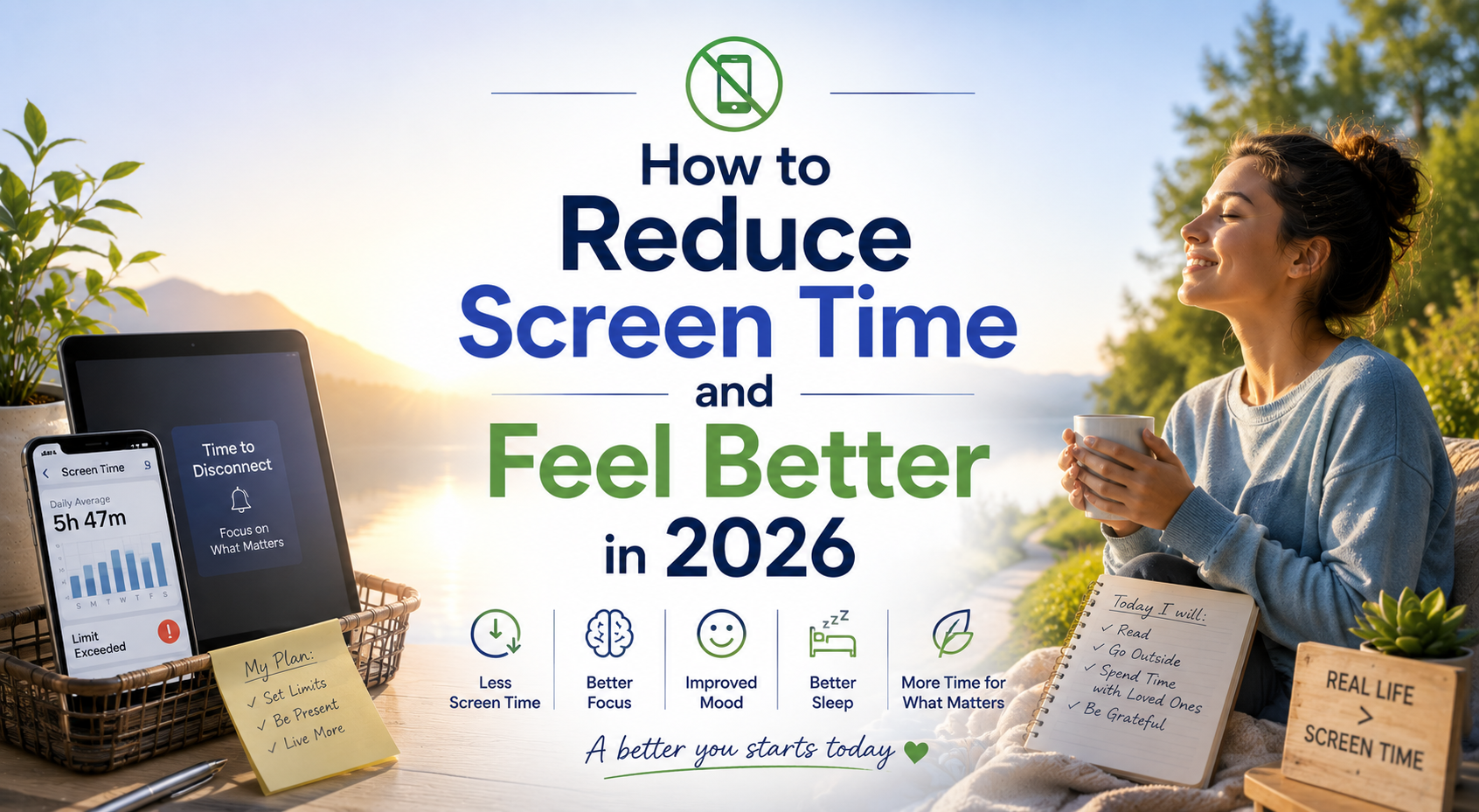
The average person in 2026 spends over six hours per day staring at screens — and roughly half of that time is passive scrolling rather than intentional use. Mental health researchers have linked excessive screen time to increased anxiety, disrupted sleep, shortened attention spans, and what some call “comparison fatigue” from constant social media exposure. A digital detox does not have to mean throwing your phone in a lake. It means creating deliberate boundaries around technology so that you are using it rather than being used by it.
Understanding Your Current Screen Relationship
Before you can change your relationship with screens, you need an honest picture of it. Most people significantly underestimate how much time they spend on their phones because the usage is fragmented across dozens of micro-sessions throughout the day.
Using Built-In Screen Time Tracking
Both iOS Screen Time and Android Digital Wellbeing provide detailed app-by-app usage breakdowns. Spend one week simply observing without changing anything. The data is usually surprising — and motivating. Most people find they spend 2-3 hours per day on one or two apps they had not consciously identified as a problem.
Identifying Your Trigger Patterns
Phone overuse follows predictable triggers: boredom, anxiety, social discomfort, transition moments between tasks, and habit cues like picking up the phone first thing in the morning. Identifying your specific triggers is more effective than general willpower-based attempts to use your phone less.
The Science of Smartphone Addiction and Mental Health
Social media platforms are designed using variable reward schedules, the same psychological mechanism behind slot machines. Each scroll delivers an unpredictable mix of interesting and uninteresting content, creating a compulsive checking behavior that is extremely difficult to interrupt through willpower alone.
Cortisol and Constant Connectivity
Always-on connectivity keeps the nervous system in a low-grade alert state. Research from 2023 found that simply having a smartphone visible on a desk reduced available cognitive capacity, even when the phone was face-down and silent. Removing the phone from sight during focused work recovered this capacity.
Social Comparison and the Instagram Effect
Social media consumption is associated with upward social comparison — comparing your life to curated highlight reels of others. Studies consistently find that passive social media consumption (scrolling and viewing without posting or interacting) is the most harmful form of use, while active interaction has neutral or mildly positive effects.
Practical Digital Detox Strategies That Work in 2026
These evidence-backed approaches range from small daily habits to structured detox periods, and work whether you are dealing with mild phone overuse or more serious smartphone dependency.
The First-Hour Rule
Do not check your phone for the first hour after waking up. This single habit change is consistently rated as one of the most impactful by people who have reduced their screen time. The first hour sets the cognitive and emotional tone for the day. Starting it with email or social media puts your attention immediately in reactive mode.
App Deletion vs. Limits
Time limits set within apps or through Screen Time are easy to override when you are in the grip of a habit loop. Deleting the most problematic apps from your phone entirely and accessing them only through a browser creates enough friction to break automatic behavior. Most people find they use these platforms 60-80% less after deletion, without missing them.
Phone-Free Zones and Times
Designating specific times and places as phone-free is more effective than trying to use your phone less in general. Common choices: bedroom after 9 PM, dinner table, the first 30 minutes of the workday, and any social gathering where you want to be present.
Digital Detox Approaches Compared
| Approach | Difficulty | Effectiveness | Time Commitment | Best For |
|---|---|---|---|---|
| First-Hour Rule | Low | High | Daily | Beginners |
| App Deletion | Medium | Very High | One-time | Heavy social media users |
| Phone-Free Zones | Low | High | Ongoing | Everyone |
| Weekend Detox | Medium | High (short-term) | Weekly | Reset and reflection |
| Full 30-Day Detox | High | Very High | 30 days | Breaking deep habits |
What to Replace Screen Time With
Reducing screen time creates a void that needs to be filled deliberately. The research on habit change is clear: you cannot simply stop a behavior; you must replace it with something. The replacement activity should fulfill the same underlying need the screen time was meeting.
For Boredom and Stimulation
Physical books, podcasts (without a screen), walking without headphones, and craft hobbies (drawing, knitting, cooking) fulfill the stimulation need without the compulsive loop of scrolling. Many people find these activities more satisfying per unit of time than screen-based entertainment.
For Social Connection
Phone calls, scheduled in-person time, and community activities (classes, sports, volunteering) fulfill social connection needs more deeply than social media, which provides parasocial connection (the feeling of being near people without genuine reciprocal interaction).
Frequently Asked Questions
How long should a digital detox last?
Research suggests that a minimum of 72 hours is needed to break the automatic checking behavior and notice meaningful changes in mood and anxiety. Longer structured detoxes (7-30 days) produce more lasting habit changes but require planning around professional communication needs.
Can a digital detox help with sleep?
Yes. Blue light from screens suppresses melatonin production, delaying sleep onset. Beyond the light effect, the cognitive and emotional stimulation from social media and news consumption before bed significantly increases sleep onset time and reduces sleep quality. A phone-free bedroom rule is one of the most evidence-backed sleep hygiene interventions.
Is it possible to do a digital detox while working from home?
Yes, with structure. The key is separating work-related and personal screen use, creating clear start and end times for work, and removing personal social media apps from work devices. Many remote workers find that scheduling specific “offline” hours during the day (without missing work communications) dramatically improves both productivity and wellbeing.
What happens to your brain during a digital detox?
Studies show that dopamine receptors begin to recalibrate within 48-72 hours of reducing compulsive screen use, making real-world activities feel more rewarding. Anxiety typically dips after an initial 24-48 hour increase as the nervous system adjusts to lower stimulation levels. Attention span measurably improves after 7-10 days.
Conclusion
A digital detox in 2026 is not about rejecting technology — it is about reclaiming intentionality. Start with the data: look honestly at your screen time, identify your trigger patterns, and choose one concrete change to make this week. Whether it is deleting your most-used app, making your bedroom phone-free, or simply waiting one hour before checking your phone in the morning, the cumulative effect of small changes is well-supported by research. Your attention is your most valuable resource. A digital detox is simply the practice of deciding where it goes.